

Cat castration

Castration in cats, often seen as a routine procedure, plays an important part in keeping our four-legged friends healthy and content. The procedure, which matters for both toms and queens, not only helps to curb excessive breeding and the growing number of stray cats but also has a significant effect on the animal’s health.
In this article we cover the following: what castration in cats is and what it involves, how the terms sterilisation and castration differ, when is the best time for the procedure, and the arguments in favour of early castration. We also look at how to prepare a cat for the procedure, the period after castration, and the general pros and cons of this medical procedure.
Castration in cats – what is it? What does it involve?
Castration in cats is a veterinary procedure that permanently renders the animal infertile by removing the gonads – the ovaries in queens and the testicles in toms. It is a surgical method that not only prevents animals from breeding but also eliminates conditions affecting the reproductive organs and reduces the production of sex hormones.
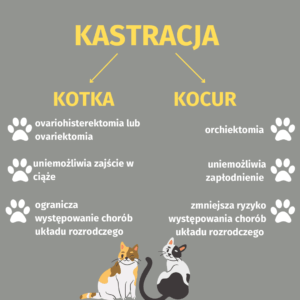
Castration of queens
In queens, castration may take the form of an ovariectomy, that is, removal of the ovaries, or an ovariohysterectomy (OVH/OH), which means removing both the ovaries and the uterus. An ovariectomy stops the queen’s reproductive cycle and makes pregnancy impossible, but it does not eliminate the risk of uterine conditions such as pyometra. An ovariohysterectomy is a more comprehensive procedure that prevents both pregnancy and uterine disease.
Castration of toms
In toms, castration involves an orchiectomy, that is, amputation of the testicles. This makes it impossible for the male to breed and reduces the production of sex hormones, which lessens aggression and behaviour driven by the sex drive.
Castration versus sterilisation – what is the difference?
Castration and sterilisation are two different veterinary procedures intended to prevent animals from breeding. Although both result in infertility, they differ in method and in their consequences for the animal. In everyday speech the terms sterilisation and castration are often confused – the former is frequently and wrongly applied to queens when in fact they are being castrated. Both terms relate to preventing animals from breeding, but they differ considerably in the procedure involved and in its effects on the animal.
Castration – effects, behaviour, health
Castration is the surgical removal of an animal’s reproductive organs. As mentioned above, in males (toms) it means removing the testicles (orchiectomy), and in females (queens) removing the ovaries and sometimes the uterus as well (ovariectomy or ovariohysterectomy).
Sterilisation – effects, behaviour, health
Sterilisation is a procedure that involves ligating the fallopian tubes in females or the vas deferens in males. Unlike castration, the reproductive organs remain in the body, but the animal becomes infertile.

Castration in cats – when is the best time?
As already noted, castration is an important procedure that benefits both the animal’s health and the control of the cat population. The decision to castrate should be made after consulting a veterinarian, but there are some general guidelines on the best time for the procedure.
What is the optimal age for castration? Cats are recommended to be castrated between 3 and 5.5 months of age, before the cat reaches sexual maturity. Early castration – recommended by researchers and specialists around the world – can help to avoid or reduce many problems, including a cat marking its territory with very strongly scented urine.
It is worth stressing, however, that a cat can be castrated at any age. Advice on early castration cannot always be followed, for example when an older animal is adopted from a shelter. Even so, in what follows we set out the case for having the procedure done as early as possible where circumstances allow.
Early castration in cats – the advantages
Early castration has become something of a gold standard in veterinary practice. Here are some of the key benefits of this approach:

How to prepare a cat for castration?
Preparing a cat for castration is key to keeping it safe and healthy. Here are the steps to take:
A check-up with the vet and blood tests
Before the castration is scheduled, a check-up with a veterinarian is required. At this visit the vet will assess the cat’s general health and decide whether it is fit for surgery. It is important that the cat has no contraindications such as kidney or liver disease, infectious disease, cardiorespiratory failure or problems with blood clotting. Blood tests are carried out for this purpose.
Fasting before the procedure
Fasting is a key part of the preparation. Young cats should fast for 6 hours, while older cats may need to fast for as long as 12 hours before the procedure. In addition, water should be taken away two hours before the procedure.

Preparing a place at home
Make sure there is a warm, quiet place at home where your cat can rest after the procedure. You can put a warm hot-water bottle in its bed for extra comfort. It is worth doing this before you set off for the procedure – your pet will need the right conditions immediately after castration, and this way you will have time to get everything you need.
Caring for your cat after the procedure. The animal’s recovery
After castration your cat needs particular care so that it is comfortable and recovers quickly. Here are two key pieces of advice:
Providing comfort and quiet
After castration a cat may feel weak and disorientated. It is important to set up a quiet, warm place where it can rest. Somewhere quiet, away from noise and household comings and goings, is ideal.
Hygiene and monitoring your cat’s health
In the first hours after the procedure a cat may have difficulty controlling its bodily functions. Have soft absorbent pads ready for it. Check the wound regularly – it should be clean and dry. If you notice anything worrying, such as redness or swelling, contact your vet.
Meals suited to the cat’s condition
After castration a cat’s diet needs a gentle adjustment. In the first few days after surgery, give it easily digestible food in smaller portions but more often than usual. This will help to keep its strength up and prevent stomach problems. We look at feeding in more detail below.
Recovery – wound healing
How long the wound takes to heal after castration varies and depends on a number of factors, including the animal’s age, its general health and how closely the post-operative instructions are followed. One interesting aspect of the process is that the wound after castration usually does not need stitches. It is small enough to heal naturally.
In most cases wounds after castration in cats close and heal fairly quickly. Under normal circumstances you can expect the wound to be almost completely healed within about 7 to 10 days. It is worth remembering, though, that even if the wound looks healed on the outside, the internal tissues may take somewhat longer.
It is also essential to check the wound regularly for any signs of infection. Redness, swelling, an unpleasant smell or discharge should all prompt you to contact your vet. If you have any doubts or notice worrying symptoms, consulting a professional is always the best option.

Healthy feeding after castration
The hormonal changes that follow castration can affect a cat’s metabolism, so it is important to adjust its diet to avoid weight gain.
A balanced diet – the right food
Choose food formulated specifically for cats after castration: it is balanced and has a reduced calorie content. Food of this kind helps to maintain a healthy weight and provides all the necessary nutrients.
Introducing mixed feeding
Consider introducing mixed feeding, combining dry and wet food. Wet food is particularly important because it helps to maintain proper hydration, which is key to the health of a cat’s urinary tract.
Constant access to water
Make sure your cat always has access to fresh, clean water. Good hydration is essential for keeping the kidneys and urinary tract healthy.
The pros and cons of castration in cats
Castrating a cat is a decision that calls for weighing up both the benefits and the potential risks of the procedure. Here is an overview of the most important points.
The advantages of castration in cats
The disadvantages of castration in cats
The lists of pros and cons above distil the key points to consider when deciding on a medical intervention in our animals’ bodies. It is worth remembering that castration is an extremely common procedure, performed every day on many feline patients around the world. It is rightly associated with safety and with many benefits.
Summary
Castration in cats is a key part of responsible care for our four-legged friends. The procedure not only helps to control the cat population but also has a significant effect on their health and behaviour.
On the one hand, it helps to prevent unwanted litters, which matters a great deal given the problem of animal homelessness. On the other, it reduces the risk of many diseases, including tumours of the reproductive system.
What is more, castration often changes cats’ behaviour, reducing aggression and territory marking in males. This can make life with a castrated cat more harmonious and less stressful for both the animal and its owner.
That said, in view of the potential drawbacks, castration is also a decision that calls for responsible thought about our pet’s welfare. It is a surgical procedure that carries some risk of complications and is irreversible. In addition, cats may be more prone to putting on weight after castration, which calls for an appropriate diet and regular physical activity.